
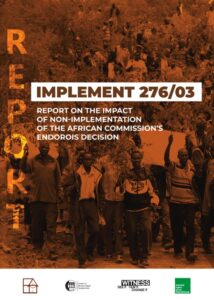
NEW: Report on the Impact of Non-Implementation of the African Commission’s Endorois Decision
The Kenyan Government Must Face up to its obligations to the Endorois Community
The repeated failure by the Kenyan government to implement the decision of the African Commission on Human and People’s Rights in the Endorois case deepens decades of inequality, neglect and abuse.
On April 4 2022 WITNESS together with a coalition of NGOs advocating for the full implementation of the Endorois decision by the African Commission on Human and People’s rights issued a report today on the non implementation of the decision twelve years after. The coalition which is made up of WITNESS, Centre for Minorities Right Development (CEMIRIDE), Endorois Welfare Council (EWC) and Minorities Rights Group International (MRG), released the report which documents how the loss of the Endorois ancestral land has led to a vicious cycle of impoverishment and underdevelopment of the community.
In the 1970s, the Endorois, Indigenous Peoples in Kenya, were evicted from their ancestral land in and around Lake Bogoria to pave the way for the creation of a national park and tourist facilities. This was done without consultation or adequate and effective compensation for the community. In 2003, the Endorois community through the Centre for Minority Rights Development, Minority Rights Group and with support from WITNESS filed a complaint with the Africa Commission. In a landmark decision, the African Commission in 2009, concluded that the Endorois eviction from their Indigenous land violated their human rights. This decision was upheld by the African Union in 2010, setting a major legal precedent by recognising for the first time in Africa, Indigenous peoples’ rights over traditionally owned land and their right to development.
Twelve years after the African Commission’s decision, the situation has only worsened as the Kenyan government’s refusal to implement the decision has left the Endorois people desolate and in extreme poverty. The devastating human cost of a tourist destination is the lived experience of the Endorios people. Although the Lake Bogoria area is endowed with natural resources and continues to yield substantial revenue, the Endorois are yet to reap its benefits and their displacement has resulted in poor access to amenities such as healthcare, clean water, and education. The Endorois, including women and children, have to walk long distances(as far as 24 kilometres) to fetch water. The only other alternative is to buy water – an expense most community members cannot afford.
“It’s possible to spend Ksh500 ($5) in one day on water. And many of us just rely on our animals. We don’t have any other work. So, water is many times a luxury.” – Madam Fancie Kiprotich, a member of the Endorois Women’s Forum
The registration of the Endorois Welfare Council (EWC) is the only recommendation of the African Commission’s decision that has been fully implemented. Two other recommendations – around the payment of royalties and the provision of unrestricted access to Lake Bogoria and surrounding areas – have seen tokenistic implementations. There is an inextricable link between the collective land rights of Indigenous peoples, and their right to self-driven development. The ownership, use, control over and the management of land, all directly affect the enjoyment of a wide range of socio-cultural and economic rights.
“The lack of implementation of regional decisions by the Government of Kenya continues to cast a shadow on progressive litigation recognizing the land rights of indigenous communities” – Eunice Olembo, Africa Legal Officer, Minority Rights Group International – Africa Office.
The adoption of the Community Land Act in 2016, is a significant step forward for securing Indigenous communities’ land rights in Kenya, however, the lack of implementation calls to question the political will of the Kenyan government to prioritize the protection of Indigenous peoples’ rights in the country.
“We take note and applaud the Kenyan government for finally acknowledging the existence of Indigenous peoples in Kenya. We thus expect that the government should move with speed to ensure that Indigenous communities, starting with the Endorois, secure their rights to land. For indigenous peoples, realisation of their land rights is critical, if their food security, as envisioned in the United Nations Declaration on the Rights of Peasants and Other People Working in Rural Areas (UNDROP) is to be achieved. Government should thus implement the recommendations of the UN Universal Periodic Review (UPR) which include implementation of the Africa Commission’s Decision on the Endorois.” – Nyang’ori Ohenjo, Executive Director, Centre for Minority Rights Development.
Kenya cannot effectively fight poverty and the associated problems of illiteracy, unemployment and poor health if a significant proportion of its population is poor. A true commitment to the protection of the Indigenous people in Kenya demands that the government fulfills its obligation under the international and national laws that it is bound by. The report puts forward the following recommendations:
Recommendations
1. The government should constitute a new task force on the implementation of the African Commission’s Endorois Decision. The composition of the task force should include representation of the Endorois and Indigenous Peoples’ Rights Experts.
2. The National Land Commission, according to Section 15 of the National Land Commission Act, 2012, read together with Article 2 (5) of the Constitution of Kenya, 2010, should adopt and fully implement the Endorois decision.
3. The government should immediately facilitate the development of an inventory/register of Indigenous peoples in Kenya and hence protect their lands.
4. Government should pass benefit-sharing legislation as required by the Constitution of Kenya 2010.
5. Endorois benefit-sharing mechanisms and structures should be expanded to include the representatives of the EWC.
6. The government should provide data on internally displaced persons because of ethnic conflicts, climate change and development projects and ensure that their rights and issues are adequately addressed.
7. The African Commission on Human and Peoples Rights (ACHPR) should step up its efforts to engage with the Kenyan Government on the implementation of its decision on the Endorois complaint.
8. Donors and development actors should support capacity building of government officers in charge of the implementation of the rights of marginalized communities to enable them to understand the importance and value of securing the rights of Indigenous communities in national government development.
9. CEMIRIDE, WITNESS and MRG and other civil society groups should support advocacy efforts of the Endorois community to implement the African Commission’s decision.
Help us amplify calls for justice for the Endorois by joining our online campaign that is also meant to increase the visibility of the Endorois Report. Use the #Implement276 or #Justice4Endorois across social media.