
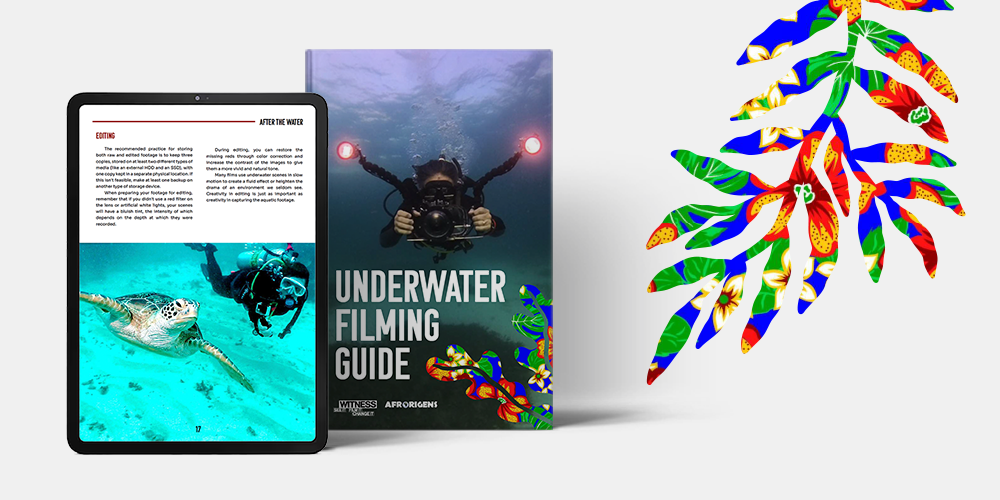
WITNESS and AfrOrigens project Launch Underwater Filming Guide
In November, WITNESS and partners in Brazil launched new guidance on collecting underwater audiovisual evidence, aiming to strengthen community efforts to protect their territories, defend their rights, and preserve historical memory. Available in Portuguese and English, the Underwater Filming Guide brings together technical instructions and practical recommendations to support communities and research groups working to document submerged environments.
The guide outlines methods for planning safe dives, producing stable footage, and capturing relevant scenes for advocacy, environmental monitoring, and historical investigation. For those documenting underwater environments for the first time, it offers step-by-step guidance on advance planning, safe practices before and during water entry, attention to currents and weather conditions, and recommendations for preserving collected footage.
According to Natalie Hornos, Program Manager at WITNESS, the launch of the guide in partnership with AfrOrigens is an important step in supporting the investigation of environmental crimes, the documentation of violations, the recording of historical events, and the strengthening of community knowledge about aquatic ecosystems.
“Images produced over time are powerful records for revealing stories that have been erased. That’s why we support documentation methods and initiatives that strengthen struggles for justice and reinforce the defense of traditional territories,” Hornos says.
With increasing environmental violations in rivers, oceans, and coastal communities, recording and reporting abuses has become an essential practice. The guide seeks to strengthen the autonomy of communities and activists who use audiovisual tools to protect ecosystems and maretórios, demand justice, and safeguard memory.
This is the latest step in our partnership with AfrOrigens, a collective that works with quilombola communities in Brazil to strengthen their struggles through research, education, and audiovisual documentation. For readers outside of Brazil, quilombo is a term used in Brazil to describe communities founded by formerly enslaved Africans and/or their descendants, who often settled in remote areas to preserve their autonomy and culture. A quilombola community refers to the people who live in these settlements, maintaining their traditions, collective land rights, and cultural heritage while resisting historical and ongoing social and economic marginalization.
Part of AfrOrigens’ work includes collecting underwater audiovisual evidence from shipwrecks off the coast of Brazil, particularly of slave ships dating back to colonial times. These sites hold important historical and political significance for communities seeking recognition, justice, and reparations.
Case Study: Brigue Camargo
The guide includes a detailed case study on the Brigue Camargo, a slave ship deliberately sunk in 1852 in the Angra dos Reis region (Rio de Janeiro state) to conceal its traces, two years after the enactment of the Eusébio de Queirós Law, which abolished the transport and trade of enslaved people in Brazil.
The story of the shipwreck remained alive for generations in the collective memory of the Quilombo do Bracuí, a community that played a central role in the investigations carried out by researchers from the AfrOrigens project, the Federal Fluminense University (UFF), the Federal University of Sergipe (UFS), and the international Slave Wrecks Project.
The identification of the underwater site Bracuí I in 2023 revealed fragments, structural remains, and other elements preserved on the riverbed. Footage captured during the dives helps confirm historical details, protect archaeological heritage, and highlight the importance of preserving a territory deeply marked by colonial violence.
The guide is available for free at wit.to/FilmagemSubaquatica.
About AfrOrigens
AfrOrigens is an archaeological research initiative focused on the African Diaspora in Brazil, dedicated to investigating aspects of this historical period that remain under-documented. The project works to expand public access—within Brazil and internationally—to information on Atlantic crossings and shipwrecks of vessels involved in the transatlantic trafficking of enslaved people, highlighting the importance of these sites as material evidence of crimes against humanity.