
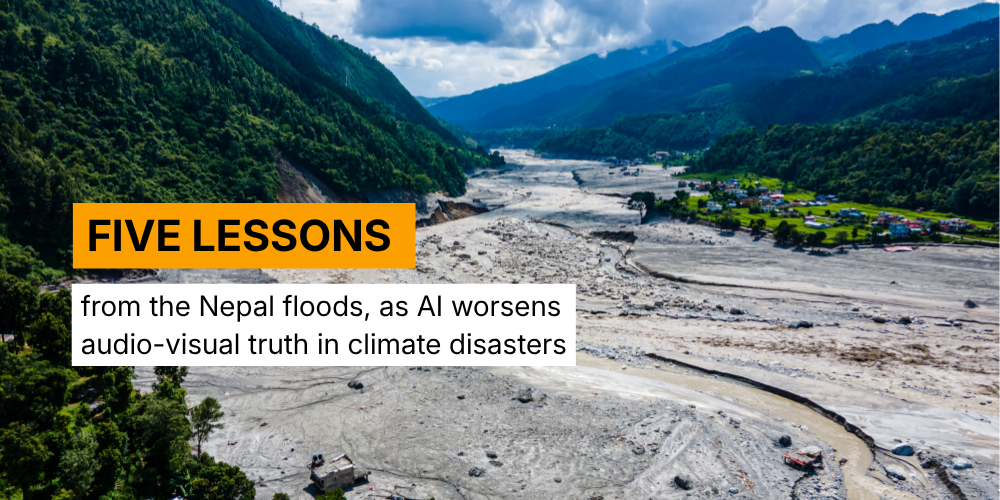
WITNESS releases report on five lessons from the Nepal floods for verifying what’s real
WITNESS has released a new report examining five lessons from the Nepal floods for verifying what’s real in the age of AI. Drawing on cases investigated by fact-checkers and on WITNESS’ work, the report examines the limits of AI detection, the growing role of technology companies in determining what is real, and why human investigation remains essential in a crisis.
On 26 August, a glacial collapse high on the Nepal-Tibet border sent a wall of ice, rock and water down the Bhote Koshi and Trishuli valleys. More than 1,380 people were killed in Nepal and over 5,100 remained missing. Within hours, social media filled with footage of the disaster. Some of it was real, but much of it was not. Fact-checkers identified AI-generated videos, footage recycled from other disasters, and authentic footage that was mistakenly questioned as AI-generated. Some fake videos also disputed the cause of the disaster, attributing the floods to a Chinese-built dam or a missile strike rather than the documented glacial collapse.
The cases from Nepal reveal a broader challenge in how we establish what is real during a crisis. The problem is not only the volume of AI-generated content, but also the limits of the tools available to identify it, the growing role of technology companies in determining what can be verified, and the importance of human investigation and context.
Drawing on these cases and WITNESS’ broader work on AI detection and verification, five lessons emerge about what needs to change: the same fake footage can resurface across different disasters, creating repeated work for local fact-checkers; AI detection struggles with disaster footage, particularly non-facial content affected by compression and editing; and the tools used to establish what is real increasingly sit with the same companies that generate synthetic content. At the same time, human investigation remains essential, with journalists and fact-checkers using geolocation, satellite imagery and open-source intelligence to verify footage.
Finally, what happens after content is identified matters: without clear criteria, removing AI-generated or “sensational” content can also remove documentation, journalism and legitimate expression.
What WITNESS is calling for
WITNESS has run the Deepfakes Rapid Response Force (DRRF) since 2023, connecting journalists, fact-checkers and human rights defenders with detection experts to investigate challenging cases of potential AI-generated content. The Nepal cases reinforce a broader lesson from this work: AI detection is one part of verification, not a definitive verdict.
The report also calls for provenance to be built in by default, with signals that can be read across companies and surfaced where content spreads; detection tools that communicate uncertainty rather than reducing assessments to binary results; and greater investment in local fact-checkers and open-source investigators. It also recommends contextual labels before removal, as well as making government requests to remove content and the outcomes of those requests public.
These recommendations echo calls from the humanitarian sector. The IFRC’s World Disasters Report 2026 calls on technology platforms to prioritize trusted humanitarian, health and local information during crises, provide low-bandwidth and multilingual tools, and moderate harmful content transparently. It also calls on states to invest in evidence-based regulation and stronger local information systems.
Read the full report for the detailed case analysis and complete recommendations.