
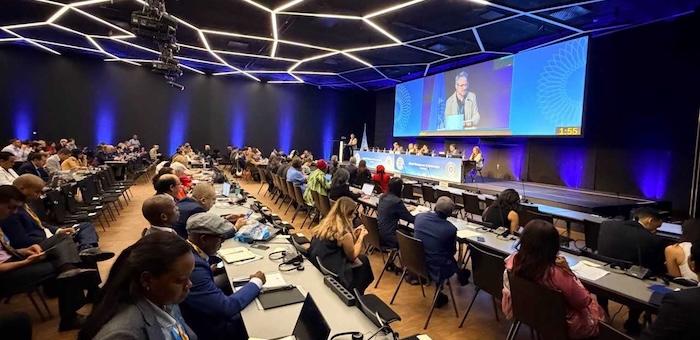
At the UN Global Dialogue on AI Governance, WITNESS Calls for Human Rights to Shape the Future of AI
“Artificial intelligence is no longer simply raising ethical questions—it is reshaping the very conditions under which societies determine what is real.”
Sam Gregory, Executive Director, WITNESS.
That was the central message WITNESS brought to the inaugural Global Dialogue on AI Governance in Geneva. As governments and international institutions debate the future of AI, WITNESS warned that generative AI has become a systemic threat to our shared reality, undermining the credibility of evidence, weakening democratic discourse, and making it increasingly difficult to distinguish authentic documentation from synthetic content.
From 6–7 July 2026, the United Nations convened the inaugural Global Dialogue on AI Governance, bringing governments, international organisations, industry, academia, and civil society together to shape a shared approach to governing artificial intelligence. The Dialogue reflected a growing global consensus: while AI holds immense potential to transform societies and economies, it also presents profound governance challenges that demand coordinated, human rights-based responses.
It was in this context that WITNESS highlighted a challenge that cuts across every conversation on AI governance: the erosion of trust in authentic information. Sam Gregory, WITNESS’ Executive Director in his submission underscored that threats of AI are no longer hypothetical. Around the world, synthetic media is already being used to impersonate public figures, fabricate footage from conflict zones, and generate non-consensual intimate imagery at scale. Furthermore, the harm caused by this technology erodes trust in journalism, threatens justice and accountability, and disproportionately impacts those documenting human rights abuses.
To address this crisis, WITNESS proposes that governance focus on two primary outcomes: establishing robust authenticity infrastructure and content provenance that prioritizes privacy and human rights, and ensuring that interoperability frameworks align with existing human rights conventions like the AI Act. In addition, the organization calls on governments to mandate a multistakeholder working group on content authenticity and information integrity, ensuring that global civil society is meaningfully included in the development of these essential safeguards.
Many of the priorities WITNESS advanced during the Dialogue are echoed in the Civil Society Readout Report of the inaugural UN Global Dialogue on AI Governance. While recognising the Dialogue as an important first step, the report calls for a more equitable, inclusive, and human rights-based approach to global AI governance. It highlights persistent challenges, including power imbalances between the Global North and Global South, the underrepresentation of marginalized communities, and the need to place human rights at the centre of AI governance.
WITNESS helped shape these recommendations through its active participation in two of the five civil society coalitions that contributed to the report—the Global Digital Rights Coalition and the MAP-AI Project. Working alongside partners across the broader civil society ecosystem, WITNESS advocated for stronger, more meaningful civil society participation in global AI governance and for multistakeholder processes that reflect the perspectives of those most affected by the technology.
We look forward to continuing to contribute to this process and to seeing the Second Edition of the United Nations Global Dialogue on AI Governance build on this important foundation. If the Dialogue is to become the true “dialogue of dialogues,” it must ensure that those shaping AI governance reflect the diversity of those living with its consequences. This means creating meaningful opportunities for voices from the Global Majority, civil society, frontline communities, and those most affected by AI to participate—not only in the room, but in shaping the decisions that emerge from it.
Read the full Civil Society Readout Report
Against the backdrop of three significant events in Geneva, the Global Dialogue on AI Governance, the World Summit on the Information Society (WSIS) Forum and the AI for Good Summit, WITNESS and the Forum on Information and Democracy brought together a cross-sector group to explore a shared agenda for trustworthy information in the age of AI.
At the event we launched a new report, C2PA Content Credentials and the Surveillance Risk: Adversarial Scenarios and Governance Gaps in the Content Provenance Ecosystem. Learn more about the event, participants and our latest report here.