Author: jessicaribeiro

Reality Check

19 Nov WITNESS and partners launch Reality Check Initiative to Address the Impact of AI on Documentary

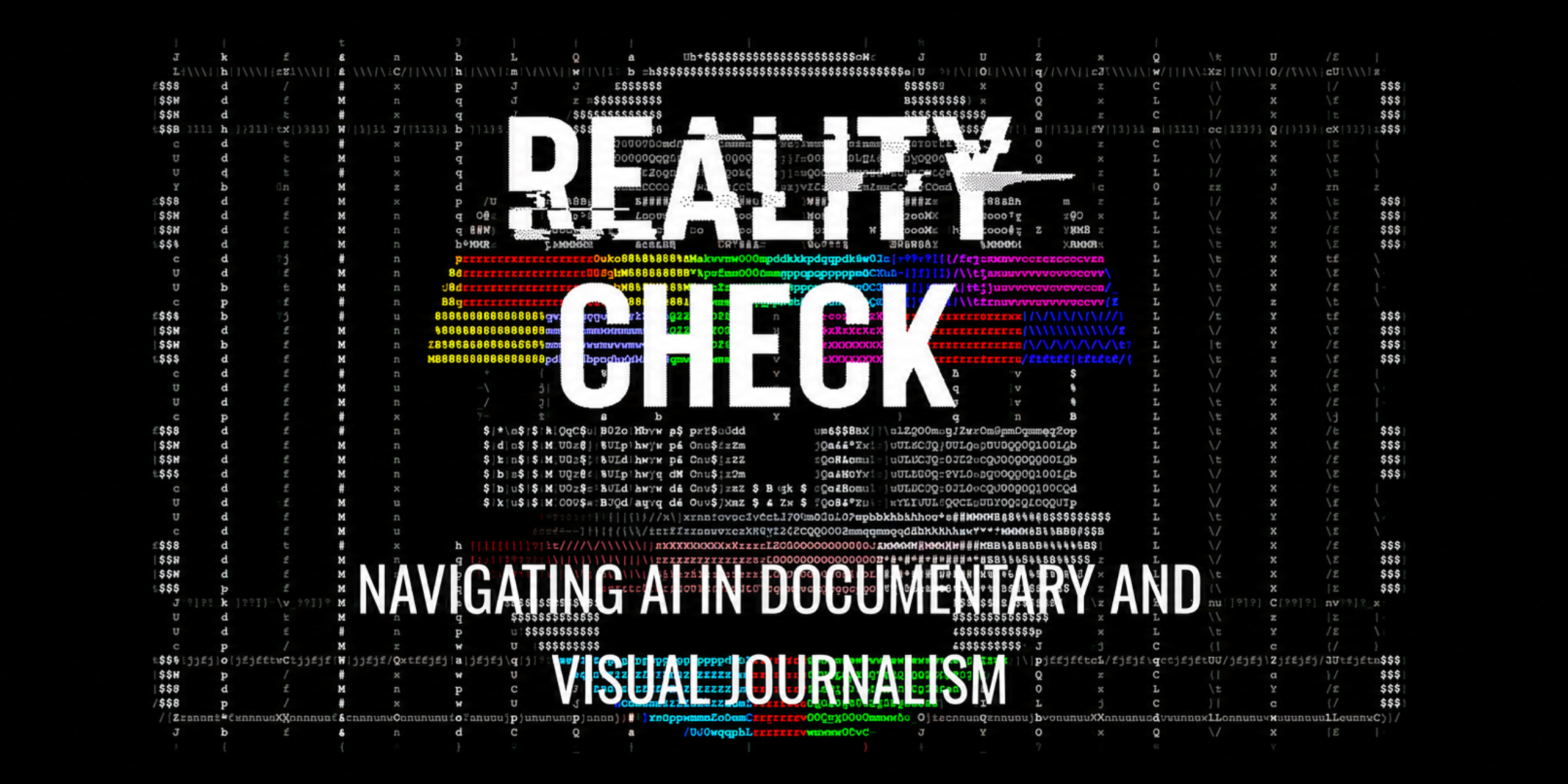
WITNESS and a group of leading organizations from the documentary and visual journalism fields have co-created Reality Check, a cross-disciplinary initiative bringing together leaders from technology, archival preservation, research, human rights, and policy to address the growing impact of artificial intelligence on nonfiction media. As generative AI becomes more common in media production and everyday life, it is changing how documentaries are made, shared, and understood. It raises important questions about what we can trust, how creative work is valued, and how AI is shaping public understanding of the world. The initiative was developed in partnership with the Co-Creation Studio at MIT, the Archival Producers Alliance (APA), and the International Documentary Association (IDA). Together, the partners aim to strengthen collaboration, research, knowledge sharing, and collective action to help documentary and visual journalism communities navigate the challenges posed by AI. For WITNESS, the challenges go beyond synthetic media. AI-generated images and videos can be used to spread misleading information, while authentic footage can also be dismissed as AI-generated, making it harder to document human rights abuses and hold those responsible accountable. These challenges affect not only how we understand images, but also how we document events and preserve evidence. “Documentaries hold
READ MORE

11 Nov WITNESS calls for stronger AI transparency rules and privacy protections in the US

As AI-generated and manipulated content becomes increasingly common online, knowing where digital content comes from and how it has been changed is becoming more important. But efforts to improve transparency must also protect people’s privacy and security. This is especially important for activists, journalists, and human rights defenders, whose work documenting and exposing human rights violations can put them at risk. WITNESS has been working with policymakers in the United States to advance legislation that helps people assess the origin and authenticity of digital content while safeguarding human rights. In California and New York, the organization has focused on strengthening rules around content provenance, AI disclosures, and personal data protection. California: Strengthening transparency and content provenance California has become a key center for AI regulation in the United States. WITNESS engages  with lawmakers on proposals addressing AI transparency and content provenance, a form of ‘watermark’ showing where digital content comes from, how it was created, and whether it has been changed. On August 17, 2026, WITNESS submitted a statement of support for California’s SB 1000, the California AI Transparency Act, recommending changes to strengthen the bill. “We are focused on ensuring that provenance requirements are based on reliable technical standards

READ MORE
Report: 5 Lessons

22 Sep WITNESS releases report on five lessons from the Nepal floods for verifying what’s real

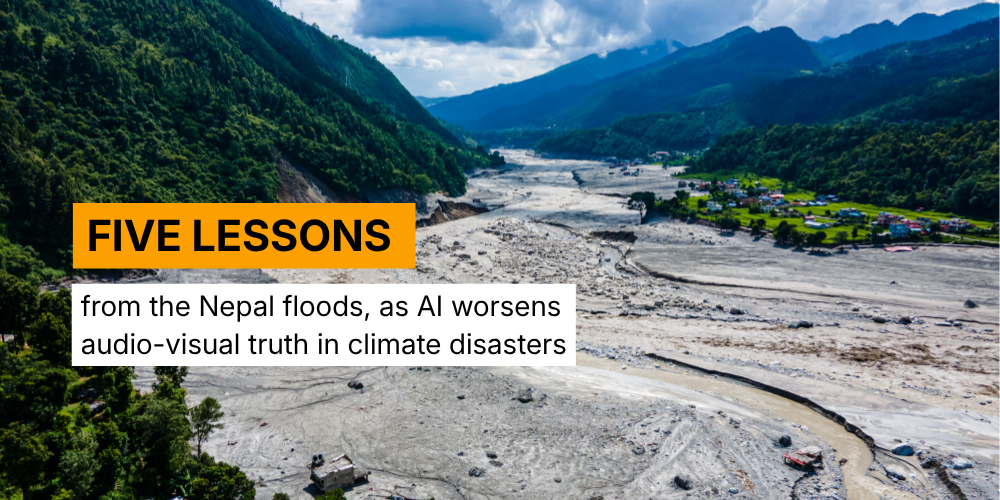
WITNESS has released a new report examining five lessons from the Nepal floods for verifying what’s real in the age of AI. Drawing on cases investigated by fact-checkers and on WITNESS’ work, the report examines the limits of AI detection, the growing role of technology companies in determining what is real, and why human investigation remains essential in a crisis. On 26 August, a glacial collapse high on the Nepal-Tibet border sent a wall of ice, rock and water down the Bhote Koshi and Trishuli valleys. More than 1,380 people were killed in Nepal and over 5,100 remained missing. Within hours, social media filled with footage of the disaster. Some of it was real, but much of it was not. Fact-checkers identified AI-generated videos, footage recycled from other disasters, and authentic footage that was mistakenly questioned as AI-generated. Some fake videos also disputed the cause of the disaster, attributing the floods to a Chinese-built dam or a missile strike rather than the documented glacial collapse. The cases from Nepal reveal a broader challenge in how we establish what is real during a crisis. The problem is not only the volume of AI-generated content, but also the limits of the tools

READ MORE
Trustworthy by Design

08 Jul WITNESS convenes experts in Geneva and launches new report on AI, content authenticity, and surveillance risks

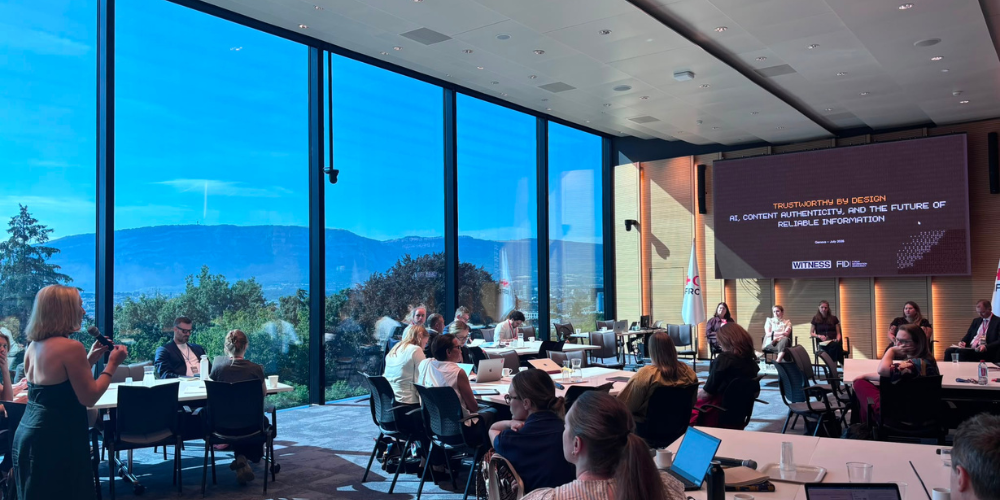
On July 8, WITNESS and the Forum on Information and Democracy hosted Trustworthy by Design: AI, Content Authenticity, and the Future of Reliable Information, a convening that brought together experts from human rights, journalism, humanitarian action, technology, research, policymaking, and standards development to discuss one of the defining challenges of the AI era: how to safeguard reliable information while protecting privacy, safety, and human rights. Across the discussions, speakers emphasized that technical solutions alone will not be enough to strengthen trust in the digital information ecosystem. They highlighted the importance of collaboration among governments, civil society, technology companies, journalists, humanitarian organizations, and standards bodies, while stressing that governance and accountability must evolve alongside AI technologies. They also emphasized that efforts to strengthen information integrity must protect privacy, civic space, and human rights. The program featured opening remarks from the International Federation of Red Cross and Red Crescent Societies (IFRC) and WITNESS, with Mahsa Alimardani, Associate Director at WITNESS, and Bruna Martins dos Santos, Policy and Advocacy Manager at WITNESS, guiding discussions throughout the day. The event also included the launch of WITNESS’s new report, presented by Jacobo Castellanos, AI Infrastructure & Governance Manager at WITNESS, alongside discussions featuring representatives from

READ MORE

Top